Ladies and gentlemen, this week’s post will be on something we
have discussed previously. The topic is mediocrity. To maintain clarity in this
discussion, let’s define terms. Mediocrity
will be defined as any state that results from one’s own decision to avoid
self-improvement. Adversary will be
defined as anything or anyone with the aim of inhibiting the individual from improving
his or herself.
This discussion will primarily go over goals, objectives and
outcomes.
Religious people view Satan or some other kind of devil as
their adversary. He and his minions are out there to cause havoc and to create
stumbling blocks along one’s path throughout life. Temptations to sin, if one
submits, can lead to one’s derailment from attaining his/her spiritual and
temporal aspirations. If the individual’s objective is to overcome the worldly
things and strengthen his or her spirituality, he or she must also defeat their
spiritual adversary. As the battle rages on, if the individual decides to stop
trying to beat the aforementioned spiritual adversary, the battle is over. The
adversary no longer needs to exert any effort on that person. He or she chose
to stop at a certain point and to just stagnate… mediocrity is the state in
which this person now dwells.
Study hard.
In school, if a student is very gifted and desires to be at
the top of the class, there will always be someone else there to pounce at the
slightest hint of slacking. This same student may also have a personality that
clashes with a particular teacher or administrator. Despite all the effort this
student puts into studying a particular subject, his or her work may be
critiqued more harshly by this teacher than perhaps some other student may be
graded. If he or she gets frustrated by the unfair treatment and throws his or
her hands up, the quest is over. Mediocrity settles in and the SOB of a teacher
wins.
Work hard.
The same thing can happen in the work place. But instead of
a teacher and a student, it would be a boss and an employee. Having one’s
contributions belittled day after day can really begin to wear on that
individual’s nerves. By giving in to the negativity created by the boss’s
attitude, the employee can stop being productive… and by extension, he or she
stops developing the skills that will lead to promotions and raises. The SOB of
a boss is the victor, because the employee settles into a state of mediocrity.
Subway loyalty card.
At the age of 17, Fred DeLuca opened a sandwich shop with a
$1,000 loan from a family friend. One year later, he opened a second. Now, 48
years after opening that first little sandwich shop, Subway has over 3,600
stores in 99 countries. Little Fred DeLuca, who only started his
sandwich-creating endeavor to earn some extra money for college, is worth over
1.5 Billion USD. During his first year in business, he realized marketing and
visibility were the two most important ingredients to expanding his success.
The biggest problem he encountered was the crappiness of his first location.
Had Fred let the mediocre location of his first store be the face of his brand
to his potential customer base, it is possible that no one outside of
Bridgeport, CT would have ever heard of a sandwich shop called Subway. But he
overcame the downside of his maiden store’s location by having a good product
and getting positive marketing out to the people who would become his business’s
patrons. He then opened additional stores in more reputable locations, while
continuing to build the brand. Fred blew past mediocrity and destroyed his
adversary in the process.
There are thousands of examples of people overcoming their
adversaries in industry, sports, entertainment, literature, academics, diplomacy,
military, etc. You name the field, there have been people exactly like you and
me who have been inspirations and leaders to their peers. The only thing that
sets them apart from the rest of their contemporaries is that they put that
little bit extra into not being mediocre. Mediocrity is of the adversary,
because if you stop trying to improve, he/she/it stops having to stop you.
Mediocrity is synonymous with self-defeat, throwing in the towel, or simply
giving up.
What the world needs now, is success... sweet success!
Ladies and gentlemen, find your passion. If you don’t have
one right now, seek one out. Something that makes you want to excel. Develop
skills, expand your knowledge, try a new approach and beat the odds. The
universe is only against you if you let it be. Don’t give in, don’t get down
and don’t give up! The world needs more excelling and less mediocrity. The
world needs you!
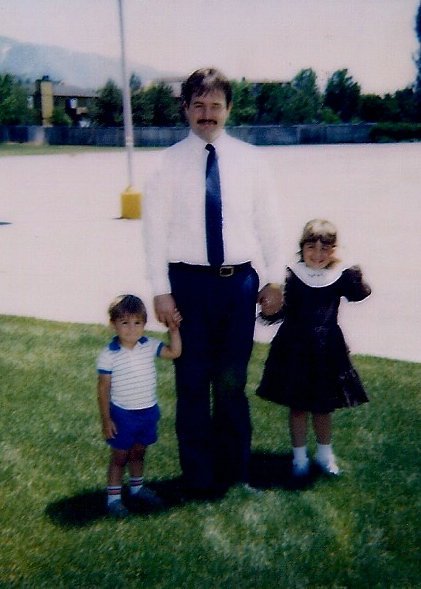
Since I was a little kid, I've been enthralled by the idea of time travel. I used to watch Back to the Future most Saturday mornings before or after running off to my soccer game each week. My obsession with the movie may have been due to the phenomenal acting or the captivating cinematography for which Back to the Future is so well known (end sarcasm). More realistically, my habit of watching that movie stemmed from my strong desire to go back in time. Back to a time before my dad had died.
In the movie, it was particularly fascinating to me that Marty McFly went back to 1955 and met his dad. This was the same year my own father was born. In my 4 year old mind (and throughout most of my growing up years), I was sure that if I could have gone back to 1955 and spent time getting to know my dad as a baby, then as a kid and eventually as a teenager, we would have been great friends. We could have squeezed a whole childhood of playing catch, fishing in nearby streams or talking about hot babes into a modified timeline.
Maybe I could have warned him that his genetics frowned upon the diet he would develop and it would lead to clogged arteries. Perhaps I could have warned him that if he didn't do things differently, he would have his first heart attack at 29, then his second (and final) heart attack only 3 years later. But then again, it is possible that his demise at such a young age was his fate. Even with my imagined warnings, perhaps he still would have had to leave our little family as a 32 year old victim of dangerously high cholesterol.
But, now that I am a grown up, and have dabbled a bit in relativity and theoretical physics, I am certain that my childhood dream of hanging out with a youthful version of my dad will not happen. Time, for now, is linear. We can only travel that line in one direction. Once time is in the past, it is there for good.
Our family sans Mom, ca. 1985
Now, let's break time down a little bit. Within a single day, we have 1,440 minutes to spend, invest, bear or waste. There are 86,400 seconds in each day. Each second that passes in which we haven't learned something, developed something, served someone or created something is just a lost period of time. Every lost fragment of time represents one in which we were not productive.
Of course, one could assume that making the most of every second would mean no time for rest or quiet contemplation. How effective would one's work be if he or she never took the time to plan or think things through? What if someone was anxiously engaged in projects non-stop? There is a good chance the end result would be a bit shoddy.
None of us are the kind of vampire made popular in the Twilight series... we have to sleep. We have to eat. Our minds, bodies and spirits require a variety of activity to stay sharp and performing at a high level. Sometimes it is wise to invest a period of time into rejuvenating one's mind and soul, so that when it is time to work again, that work will be fortified by our A-game. Taking the time to enjoy a bounteous meal can also yield great results. It can give us the strength and energy to get back to the grindstone.
Not to be squandered
Society, in the modern era, is so fast paced. Everyone is driving faster, communicating less and with fewer characters, eating fast food, getting news, studying and being entertained via high-speed broadband. But faster isn't always better. As we rush through headlines and articles on the internet, we are only skimming bits of information. We do not easily see the whole picture or gain much contextual or factual understanding. Very little is absorbed while going at the speed of light. On our freeways, we blaze through towns and cities...cutting through the intersecting lives of hundreds and thousands of people without picking up a single anecdote from that place and from those people.
We need a deliberate balance of hard work, relaxation, re-energizing and social interaction to be the best people we can be. But in order to not find ourselves 38 and living with our parents, we need to understand that it all relates to time and how we manage it. There is no age requirement in order to make an impact in this world. It isn't like trying to rent a car before you turn 25. Don't wait for the world to open a door for you, take the time you have now and make your dreams a reality (as long as your dream doesn't require a rift in the space-time continuum to be realized).
White smoke rising from chimney in Rome,
signifying the election of a new pope.
With the recent selection of a new pope, many commentators from without and members from within discussed what type of pope the Papal Conclave would select. Would he be a progressive pope? Many of them had hoped so. Projections of eventual female priests began to take over the airwaves of public radio. A lot of those same commentators and a bunch of others pondered whether or not the new Bishop of Rome would embrace homosexuality and birth control.
Salt Lake Temple for the
Church of Jesus Christ
of Latter Day Saints.
Salt Lake City, UT
On the other side of the Atlantic Ocean, and several years prior, advocates of California's Proposition 8 - a measure relating to same sex marriage - chastised churches for standing in the way of its passage and demanded that the IRS rescind the offending churches' tax exemption status. The majority of the complainants cited the 'wall of separation between church and state' as their grounds for opposing religion's opposition to the proposition. Unfortunately, those who take this approach fail to realize this wall of theirs protects the rights of the church and the rights of the citizens from having a state-imposed religion forced upon them. Nothing else. Any other interpretation is outside the construct of the United States Constitution. When the government involves itself in the moral sphere, it is stepping on the toes of religion.
Recruitment poster for
the 7th Indiana Cavalry.
Church and government are two real and powerful entities within human society. But in order for the two institutions to benefit the individual within society, he or she must understand the role of the state and the role of the church. Within that understanding, one must also understand how and why the one occasionally operates inside the other's realm. In addition to grasping the purposes of each universe, the individual needs to grasp the concept of his or her responsibility within both the state and the church and his or her relationship with each.
Religion is a realm of faith and government is a realm of reason and deliberation. Reason and deliberation require an exchange of ideas and opinions, which also requires compromise. Faith, on the other hand is something that is accepted. In government, if something seems out of place, one can effect change within government through the apparatus that exists in that sphere--namely voting or participating in committee hearings or speaking at council meetings. If something is off in a faith-based sphere, it is supposed to be the individual who changes himself or herself to bring spiritual harmony into his or her life.
Let's explore it a bit more.
Dallas City Hall by night. Dallas, TX
What is government? It is a body that directs and oversees the business of a state. In the United States, it is a democratic republic at the top, with some variation of the same concept down through state and municipal bodies. It is made up of citizens who represent themselves and other citizens. Citizens deliberate and debate to decide which laws and regulations will govern their conduct and the conduct of their fellow citizens. In principle, the laws of a state deal with private property rights, commerce and transactions, defense and how to address grievances between citizens.
Washington Monument.
Washington, DC
Active citizens in a state use reason and/or emotion to try to persuade others to support the same legislation or policies that they themselves support. Sometimes the movement is successful, other times it is not. This is the way it is supposed to work. It is individuals putting their ideas on how to better society out there, hoping to gain the support of others.
National City Christian Church
Washington, DC
Now, lets contrast that with religion. What is religion in general? A belief system. More specifically, a religion is a specific set of beliefs to which one adheres, usually in union with a number of other people. It is based wholly on faith. Through the exercise of this faith, the adherent gains strength to better himself or herself internally by accepting guidelines that suppress some natural desires and behaviors. But regardless of the specifics from one denomination to the next, religion operates in the realm of faith.
What is happening more and more in the modern era is that people are doing exactly the opposite of what they ought to be doing. Citizens are faithfully trusting government for their sustenance and to make up for their own shortcomings, while members of churches are trying to tinker with their churches' doctrines and traditions.
Catholic Church
in Victoria, KS
If a church disagrees with contraception, but an individual member supports the use of contraceptives, he or she must accept the difference, change his/her opinion or find another church that better suits his/her set of beliefs. Of course, if that doesn't work, one could organize a new church or give up religion all together.
Regardless of your politics or religion, being able to understand the purpose of each entity will bring a better understanding to your mind, on a small scale, and a better balance with more respect in society, on a large scale.You don't put faith in government, faith belongs to the spiritual and religious realms. You don't try to use reason and debate to alter a religion. Reason and consensus-building belong in the realm of government.
Martin Luther King, Jr Memorial.
Washington, DC
If you want to effect change somewhere, do it in the proper place--do it in government. If you have a disagreement with your church's theology or its exercise of tradition, then change your mind or leave your church. Trying to change the structure of a church is not your role, because through your attempt to change the faith, you infringe upon the rights of other members of the congregation. If you have a problem, and it relates to a church, change your personal stance or go somewhere else. If your problem is governmentally based, get yourself out into the public sphere. Grab your friends, family, neighbors and colleagues to help you. Effect the change that is appropriate to effect.
Ladies and gentlemen, lets look at and come up with a solution to a dilemma that has been occurring throughout human history and continues strongly today... I will call itcrisis jockeying.
This is just like it sounds.
The horse and its jockey are
representative of a public crisis and a Crisis Jockey, who rides the crisis and
tries to guide public opinion of the
crisis to maximize his or her cause's power
It is when people and institutions ride a crisis as if it were a sport, hoping for a big payout at the end. In crisis jockeying, as in horse racing, the jockey is only a small part of the team (pun intended). There are breeders who get a large share of the spoils of victory, as well. In the game of crisis, the breeders help instigate and proliferate a specific event or condition with the sole purpose of having their jockey ride it out to win the pot.
Crisis jockeys and their groups rely on hysteria to grant them power and/or money. They are the benefactors of windfall profits. Unlike big oil companies who had been getting a bad PR rap several years ago for 'windfall profits' the big crisis companies actually take windfalls. The oil companies had invested capital in their infrastructures and personnel for years. Then when market conditions shot the price of their goods upward, they were able to see an increase in profit. Rather than windfall, their profit was normal, market-based profit. The kind of profit that comes to all companies that invest money, time and manpower into an industry and are still functioning well when the market graces their industry with a boom.
Profit: 9.38% of Revenue.
Governments' cut: 22.98% of Revenue.
Percentage of revenue put back into the economy: 67.63%.
Big crisis companies (cause-specific activists, political candidates and parties, etc.) become windfall profiteers when a storm hits or an earthquake rumbles. Their profit comes from blaming a natural disaster on an opponent or one of their adversaries. After they give blame, they begin to take donations. These donations are not necessarily just monetary contributions. It can also include face time on news programs or any other platform that enables that entity or individual to evangelize for their cause. Most of them are unrelated to the actual issue about which they are talking, but they find some obscure point or undertone to link the event or condition to their cause.
Sometimes the crisis jockeying involves jockeying for political position. Since it is so fresh, think of the sequester. The sequester was a proposal offered by President Obama a year and a half ago. It was designed to push Congress into coming up with a budget (something that hasn't really happened in years). Officials in the Obama Administration claim that at the time the sequester was proposed, they never expected it to go into effect. Taking their claim at face value, we will say that their intention was to scare Congress into action. Speaking glowingly of his sequester to the Des Moines Register, President Obama referenced the program and lauded the fixing power it would grant him. However, advisers must have determined that they would be taking a different stance publicly on the sequester and asked the Register to not print certain parts of the interview. They wanted to use it as a tool against Republicans from that point onward.
Fast forward to February/March of 2013. The period of sequestration was upon us. Members of Congress and even the president went out claiming that if the sequester goes through, lines at airport security will grow dramatically, unemployment will tick up significantly (Rep. Maxine Waters claimed the sequester would cost the US economy 170 million jobs, an economy that currently only has 140 million jobs), among other dramatic and drastic things.
We were told teachers would be laid off, policemen, firemen and all sorts of other kinds of public sector employees would be let go. To the casual listener, they would hear that and immediately think of their kids' teachers or their police force. Then they would think, heaven forbid, that if their house were to catch fire, without firemen, what would be their chances? The casual listener would willingly pay more of the income they earn to save these public servants. But you aren't the casual listener, are you?
You realize that the money to pay police officers and fire fighters come from local taxes. Teachers salaries come from state level boards of education, primarily funded by local taxes (some are subsidized by the federal Board of Education, but that largely goes toward operational and curriculum-related costs). You also realize that the sequester doesn't eliminate budgets from last year's levels, rather it cuts money from this year's projected budgets. We are still spending more money under the sequester than we did last year. Yet the world is still in the process of ending.
Madam Secretary Janet Napolitano
Janet Napolitano, Secretary of the Department of Home Land Security, was asked which airports were reporting longer wait times at TSA checkpoints. She started her list off by saying: "I want to say...". However, after calls were put in to the airports she mentioned, it was clear that she was lying. Rather than reporting longer lines, each of the airports cited by Secretary Napolitano as being delayed confirmed that there were no additional delays.
The Department of Homeland Security's ICE began releasing illegal immigrants from prison (note, these were not just illegal immigrants going through the process of exportation, they were criminals serving time in prison, not jail, for prison-worthy crimes) before the sequester even became law. The releases were done in anticipation of possible budget cuts. The Arizona Daily Star reported that all 300-500 released the first day were in Arizona. Department officials have since suggested they would have to release up to 32,000 criminals back into the streets.
Also ahead of the sequester, Secretary Napolitano's department approved $50M for new uniforms for TSA agents. The math amounts to about $1,000 per uniform. As a cub scout, I had more patches than TSA agents wear and they, too, were sewn onto a blue shirt. The whole thing probably ran about $45-50. That included a hat and bandanna. Can the lighter shade of blue possibly push the cost up to $1,000?
At the White House, tours of "the people's house" have been cancelled. President Obama blamed it on the Secret Service and said he did not know about it in advance and would work tirelessly to get them back on. However, his press secretary Jay Carney didn't get the message and asserted that the White House had made the decision to cancel the tours, in association with the Secret Service. The staff that ran the tours office consisted of seven employees. Seven employees and the tours they had offered to students and tax payers had to go because of sequestration. This announcement came the same day that Secretary of State John Kerry announced an additional $60M in aid to the Syrian rebels (in addition to the $55M already pledged to the group). So, tax paying Americans visiting the nation's capital can no longer go see the inside of the White House because of budgetary shortfalls (private donations have been offered to fund the resuming of the tours, but the White House has refused), but the tax dollars the tax payers are paying gets sent off to fund opposition to Syria's brutal regime? Even if we assume the seven staffers that ran the tours are overpaid, why is that one of the first things to go?
The last piece that we will touch on is the issue of immunizations to kids in Maryland. Because of sequestration, the CDC had to cut the number of available vaccines in Maryland by about 2,050 doses. That is 2,050 fewer children getting vaccinations than would have otherwise received them. The director of the CDC, Thomas Frieden, found himself in an uncomfortable position while testifying at a congressional subcommittee hearing on the cuts. Because of some direct questioning from Maryland Rep. Harris, Frieden was forced to admit that the sequester, which cut $30M from their projected budget, forced them to cut the immunizations, BUT with the president's proposed budget's cut of $58M, the immunizations would have been saved. Do the math folks. With $28M less to spend in the budget, the CDC would have saved the vaccinations? How does that work?
The bottom line is this: people in power love being in power. The second to bottom line is this: manipulation (mass or otherwise) is the favorite tool of the powerful to stay in power. Today, the manipulation is executed with soundbites through news reports. A few centuries ago, as Niccolo Machiavelli wrote in The Prince, it was executed through raw force. Random killings in the town square would scare people into submission. Think of the Spanish Inquisition, the expansion of Ottoman Empire, Nazi and Soviet rule. The success of each of these movements was based on the exercise of power to instill fear. It has always happened and will, no doubt, continue to plague human society. Today the practitioners of this technique send experts, advisers and even celebrities into newsrooms to tell everyone how bad life will be if xyz doesn't happen. Then they say that if, by some off chance, the bad thing does happen, everyone needs to blame Company X, or the X party, or John/Jane Doe for the unavoidable misery that will follow.
To avoid being manipulated, all we need to do is think things through a bit. Who is making this claim? Why is he/she making the claim? Do all of the claim's premises add up? Is the conclusion made within the claim sound? If there is a red flag that comes up as a result of the answers to any of these questions, chances are someone is trying to dupe you. The second thing to do is be vocal about the facts surrounding the attempted duping. Speak to friends and family, colleagues and neighbors. Be the voice of reason. Without being overbearing, discuss whatever the situation may be and review the actual facts together. Then soon, you/we won't be so easily played by these crisis jockeys.
The second verse of Collective Soul's 1999 hit Run goes like this:
Is there a cure among us
From this processed sanity
I weaken with each voice that sings
In this world of purchase
I'm going to buy back memories
To awaken some old qualities
As I listened to this song the other day, I actually listened to the words for the first time. It got me thinking:
Processed sanity. Most things these days that are processed are either unnatural, modified or wholly manufactured. I liked what was being sung. It was a message that has often crossed my mind. As a whole, humanity of today is very different than it was for our ancestors a thousand years ago. Mankind is not living up to its potential. We have changed fairly dramatically over the last 2-3 generations, even.
A geneticist from Stanford University, Dr. Gerald Crabtree, has argued in the journal Trends in Genetics that we are dumber than previous generations. He even stated that an Athenian from a thousand years ago could come to our time and be smarter than all of us.
But we make cars and planes... computers and smartphones. What did the Athenians and their contemporaries make? Little carts pulled by animals? Catapults? Come on, now. But wait...
Think about that.
Someone designed a car or a plane. Someone designed and produced the electronics that we use daily. Specific individuals today combine other people's creations to make better tools for us all to use. But can you manufacture a car? Can I? Unlikely. But what about the Athenians? Sure they had markets and engaged in commerce and trade, but most any able bodied Athenian knew how to make and use the tools of his trade.
Similarly, two generations ago, my grandfather would see a problem, then with his natural ingenuity, he would engineer a solution based on what he had around him. He had the ability to do so because it was his nature... but it was also a talent that he exercised and sharpened. Sadly, what was a fairly common trait 40 years ago has now become a skill that most lack.
These Athenians are smarter than us and more resourceful... even without all their limbs.
Dr. Crabtree pointed out that the average Athenian (and I suggest we include generations up through my grandparents' generation) had to rely on his or her own memory, problem solving and critical thinking skills. The current generation is devolving in these aspects because of inactivity. Our natural brilliance is suffering from atrophy. There is no life-saving necessity to store useful information in one's brain, because at one's fingertips is something called 'Google'. For example, where a previous generation had to know the basic workings of their personal vehicles, we have Jiffy Lubes everywhere and WikiHow articles accessible on a whim 24 hours a day.
Back in the Collective Soul song, the writer states that he wants "to buy back memories, to awaken some old qualities". This is exactly what Dr. Crabtree is suggesting we are missing. Memory and old qualities.
Richard Dean Anderson as the '80s real-life superhero, MacGyver
We are too comfortable. We don't need to constantly be aware of our surroundings in case we find ourselves in a MacGyver situation, because they just don't happen for the average person anymore. We have roadside assistance, so we don't need to worry about changing a flat tire. We have 24 hour plumbing services, so we don't need to understand the pipal organization within the walls of our homes. It is almost as if our self-sufficiency skills are stuck in a self-destructive round of the Kevin Bacon game. Rather than actually knowing how to do anything, we rely on being just a step or two away from someone who can help us.
In my fraternity, we had a chapter motto (to be perfectly honest, we actually had several, but one was better than the rest): "Mediocrity is of the adversary." Regardless of what or who your present adversary may be, your apathy or your choice to settle in and get comfortable is your biggest weakness and your opponent's most potent tool. By being mediocre, or getting too comfortable, your adversary does not need to do anything. You are limiting your own growth and your own progress.
If we are not finding ways each day to gain some level of useful knowledge, if we aren't finding ways to be better today than we were yesterday, we will continue to lose our natural abilities. To that degree, we will be responsible for the dumbification of the human race. Collective Soul asks, Is there a cure among us? I say to you there is. But it can only be self-administered. Be better today than you were yesterday. Get even better tomorrow. Decide to be observant and to think critically. Next time you realize that Danny DeVito's wife's real name isn't Carla, but you can't remember it is Rhea Perlman, think through it internally before immediately turning to Google. It works.
Ideas are the genesis of all deeds and all movements throughout history. Some ideas (like mixing hazelnuts and chocolate) are great, some (like head cheese...warning: only click on the link if you have a strong stomach) are terrible. What I want to explore is what it takes for a bad idea to gain support and general acceptance.
'J' and 'K' flashy-thingying a
guy (off screen).
K, from Men in Black, said (paraphrasing): A person is smart, but people are dumb. Perhaps mob-mentality can explain humanity's general acceptance of bad ideas, but maybe there is something more. For example: How can an otherwise intelligent person consider, believe then accept that something as awful as the Holocaust is not only acceptable, but necessary?
Having lived in the former USSR, I discussed the Holocaust with several older folks who had been there when it all took place. One older gentleman told me that, for him, it took consistent bombardment from the propaganda machine to comply. This bácsi (Hungarian for old guy) told me that every Jew he knew was a terrific person. So when all the antisemitic sentiments of the Nazi party began broadcasting over the airwaves, he dismissed it. Several weeks later, he started to assume that the only good Jews were the ones he knew, because the rest of them were vermin. Looking back, he was embarrassed that he did nothing to stop the persecution of the Hungarian Jews in his village. He realized that most everyone loved their neighbors and friends who were Jews, but like he had done, assumed that all the rest were scoundrels.
* * * * *
Another one that I will never understand is the whole Y2K fiasco. Who was the first guy who suggested that computers (machines designed to process large numbers, equations and algorithms) might not be able to count from 1,999 to 2,000? Not only did the first guy think it was a big deal, but also a large enough percentage of subsequent computer geniuses that it became a worldwide scare. From a guy (or group of guys) thinking the calendar's switch from December 31, 1999 to January 1, 2000 would break computers, it snowballed. People thought their bank accounts would vanish, that planes would drop out of the sky... that mass chaos would lead to riots and economic devastation.
Think about that for a minute.
Look how frightened the computer
is of the number 2000.
Even in 1999, people could chat with other human beings across the globe through computers. Cellular technology was fairly solid and mobile web browsing and SMS were becoming more and more common. Computer models were tracking weather systems and generating solutions to mathematical conundrums at universities and research labs all over the world. But for very obvious reasons (start this sentence over and read it sarcastically, if you didn't do so the first time.), people thought that a machine, called a computer, could not compute that 2,000 follows 1,999.
Folks withdrew money, some closed accounts they had maintained throughout their adult lives. Others built bunkers and loaded up on survival gear. All of this, and for what? Why? Because they heard it was coming and that it would be bad. Hindsight is 20/20, but with a little critical thinking, foresight can also be near 20/20.
* * * * *
Las Vegas Wedding Chapel
Then there is the infamous group of students from a private religious university several years ago who thought it would be a good idea to go to Las Vegas to get married. They didn't want to get married for real, but just to engage in coital activities before getting their marriages annulled the next day. There was one person who suggested the idea: we can experience something exciting and new, without breaking any commandments regarding pre-marital chastity, then just pretend it never happened. Another person, without thinking twice, agreed that it was a brilliant plan...the letter of the law would be followed and they could get a little closer to the hot babes from the adjacent apartment. Subsequently, others (including the hot babes from the adjacent apartment) hopped on board and executed the idea.
-------Story continues below-------
Although it is common for college students to engage in promiscuous activities, this situation was a particularly ridiculous idea because of all the ways in which they justified their actions. The students could just have done whatever they wanted to do, without the sham marriage and two days later, nothing would have been different. But they spent a lot of time and money trying to trick the system. The end result is they were dismissed from the school for violating the code of conduct they swore to uphold and all the justification they could devise was meaningless.
Good rule of thumb: if one has an idea that requires an abundance of maneuvering around laws or ethics, it probably isn't a good idea. A solid idea should stand on its own merit.
This is planking... this is it.
There are plenty of plain old bad ideas out there. People all over the world are devising and supporting them everyday. Groups large and small show support for dangerous, ridiculous, evil or just plain stupid ideas on a regular basis. Why? Think about planking. People have died from falling off of buildings and bridges because they wanted to show how brilliantly awesome they were... by laying face-down, as flat as a board on everyday objects. Idiots!
Along those same lines... the whole YouTube craze where people try to do something ridiculous in order to get views. Some of the worst involve pogo sticks on treadmills or anything else that can result in broken bones and/or death. All for hits on a video sharing website.
Without going into a discussion, it is also worth noting: reality TV, the Tickle Me Elmo insanity, Furbies and mannequins with nipples.
It has always bothered me that there is a candy bar called 3 Musketeers that doesn't have three of anything in it. It is just a whipped, chocolaty, milky substance dipped in a chocolate shell. There is absolutely nothing about the 3 Musketeers that has anything to do with the number 3, with musketeers or with the literary trio known as The Three Musketeers. There is no "One for all and all for one" mentality associated with the bar at all. Why on Earth would they name the bar 3 Musketeers?
What makes me more uneasy is to realize there is an actual candy bar (made in the same factory, no less) that has three distinct elements working together in harmony: peanut, caramel and nougat. (Since the outer chocolate shell is common to both candy bars, I omit it as one of the elements.) This candy bar is not called 3 Musketeers, instead it is named Snickers. What about a Snickers bar can be associated with slightly reserved chuckles?
I realize that candy doesn't have to make sense, I learned that from Willy Wonka. So by extension, names of candy bars certainly don't need to follow a logical nomenclature system. But something this obvious should have caught the attention of Naming Committee at Mars.
To rectify the nonsense, here is my proposal: Call today's Snickers the 3 Musketeers bar going forward. The current 3 Musketeers bar should be changed to the Milky Way bar. Because it is nothing but a chocolate-covered, chocolaty milky way from end to end. This leaves the name 'Snickers' without a bar and today's Milky Way without a name. So match those two up and call it good.
-------Story continues below-------
PART 2: Authoritarian Travel Agents:
Picture yourself saving money for a long time in order to go on vacation. You want to see a new part of the world, to experience new cultures. So you collect enough money for airfare and lodging, along with cash for activities and souvenirs. You are full of anticipation and excitement! Boarding the plane, you begin to day dream of all the wonderful things you'll do, sights you'll see and cuisine you will eat.
Instead of Holiday Inn Express, let's call it Hostage Inn Express.
You land, take a cab to your hotel and begin to check in. The host at the front desk hands you your key, your meal tickets and a list of activities offered by the hotel throughout the duration of your stay. He also hands you an itinerary. As you glance over the schedule, you realize that they are only letting you leave the hotel for a few hours each day, except on the third day. On the third day, you have to stay in the hotel all day long.
The bell boy, almost instinctively, like he can read your thoughts, says: "Don't worry sir, shuffle board is very popular."
Every day their shufflin'.
Shuffle board, you think to yourself. How old do I look to this kid? Just then, you see that all of your meals will be forced upon you by the hotel staff. The menus are pre-planned and not to your specific tastes. At least there is a buffet, you tell yourself.
But as great as a buffet may be, you are trapped. You cannot go where you want to go or do what you want to do. You are given a few choices of activities, but they all involve staying put in the hotel... except for the daily guided tours.
Is this what you saved three years to do? To be a hostage guest at a hotel?
Now, for those of you who haven't made the connection, I am ranting against the cruise industry. With a cruise ship, there are four distinct differences between it and a regular, land-based hotel:
Costa Concordia partially sunk January 13, 2012 after
striking a rock.
1. The hotel will not strike an iceberg or large rocks or coral reefs to ultimately sink in the ocean. The cruise ship might.
2. The food that is served at a hotel could be brought fresh everyday. On a cruise ship, it was only fresh on the first day.
3. The hotel will not make you seasick. The cruise ship can.
4. The view from your hotel room window will not change, but on a cruise ship, it likely will. As long as you don't have a cabin facing the shuffle board court or the ocean-only side of the ship.
Sacha Baron Cohen as "The Dictator"
Think about it... the cruise industry had to have been invented by either a dictator who had a thing for planning/organizing travel or the other way around... a travel agent who had dreams of being a dictator.






 , it was executed through raw force. Random killings in the town square would scare people into submission. Think of the Spanish Inquisition, the expansion of Ottoman Empire, Nazi and Soviet rule. The success of each of these movements was based on the exercise of power to instill fear. It has always happened and will, no doubt, continue to plague human society. Today the practitioners of this technique send experts, advisers and even celebrities into newsrooms to tell everyone how bad life will be if xyz doesn't happen. Then they say that if, by some off chance, the bad thing does happen, everyone needs to blame Company X, or the X party, or John/Jane Doe for the unavoidable misery that will follow.


